

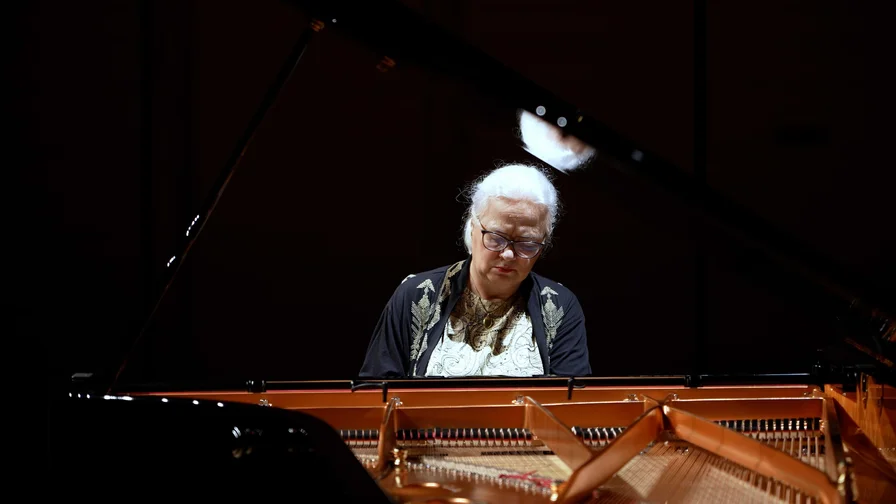
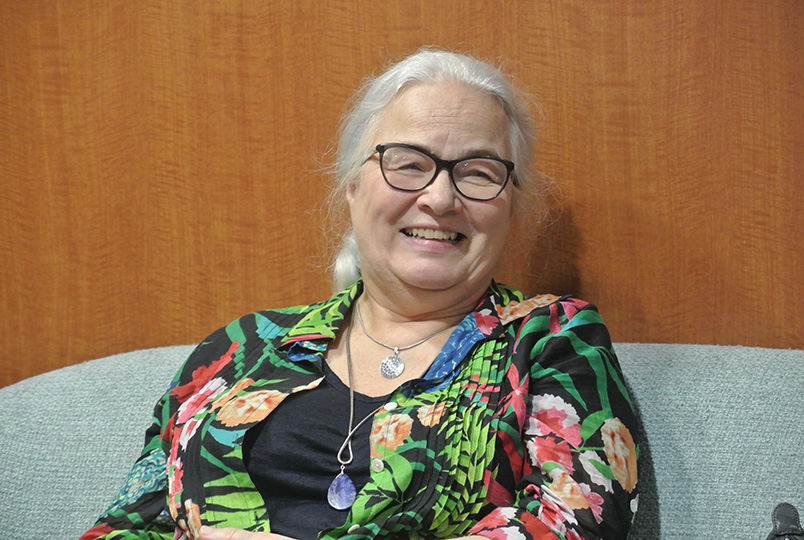
In October 2023, Ms. Ewa Pobłocka performed a recital at the Saitama Civic Center Omiya RaiBoC Hall in Saitama and at Kawai Omotesando in Tokyo. During her tour, we had the opportunity to interview her at Kawai Omotesando. Ewa achieved 5th place in the 10th Chopin International Piano Competition and also received the Mazurka Award. In recent years she has been focusing on the music of J.S. Bach, and in this interview shares insights into her encounter with Bach's music, the allure of his compositions, and her approach to tempo and pedal usage when performing.
Recitals in Saitama and Tokyo
On October 24th, you had a recital in Omiya, and the next day on the 25th, another one at the Kawai Omotesando in Tokyo.
Yes, I was delighted to see the large audience in both places, and I felt very happy to be able to play Bach which is very special to me.
In your recital in Omiya, you played works by Schubert, Chopin and Wagner-Liszt along with Bach.
Yes, all the works I play in my recitals are works that I love. My most favourite work among them is “Isoldes Liebestod” by Wagner transcribed by Liszt, which is very sad in character. When I am asked to give a recital, I am often requested to include works by Chopin, but I intentionally try to include works by other composers too.
I take plenty of time to plan my recital program so that I can consider the combination of all the elements very precisely - such as the connection of the keys and the styles etc.
Your recital at the Kawai Omotesando was an all Bach programme. You are a specialist of works by Chopin, but also known as an expert on works by Bach.
I don’t think that's true, as I play a lot of chamber music and many works by different composers, such as Schubert, Schumann, Mozart etc. But of course, after performing all of the 48 Preludes and Fugues of the "Well Tempered Clavier" I feel that my understanding of Bach is much deeper now compared to when I only played 5 or 10 of them.
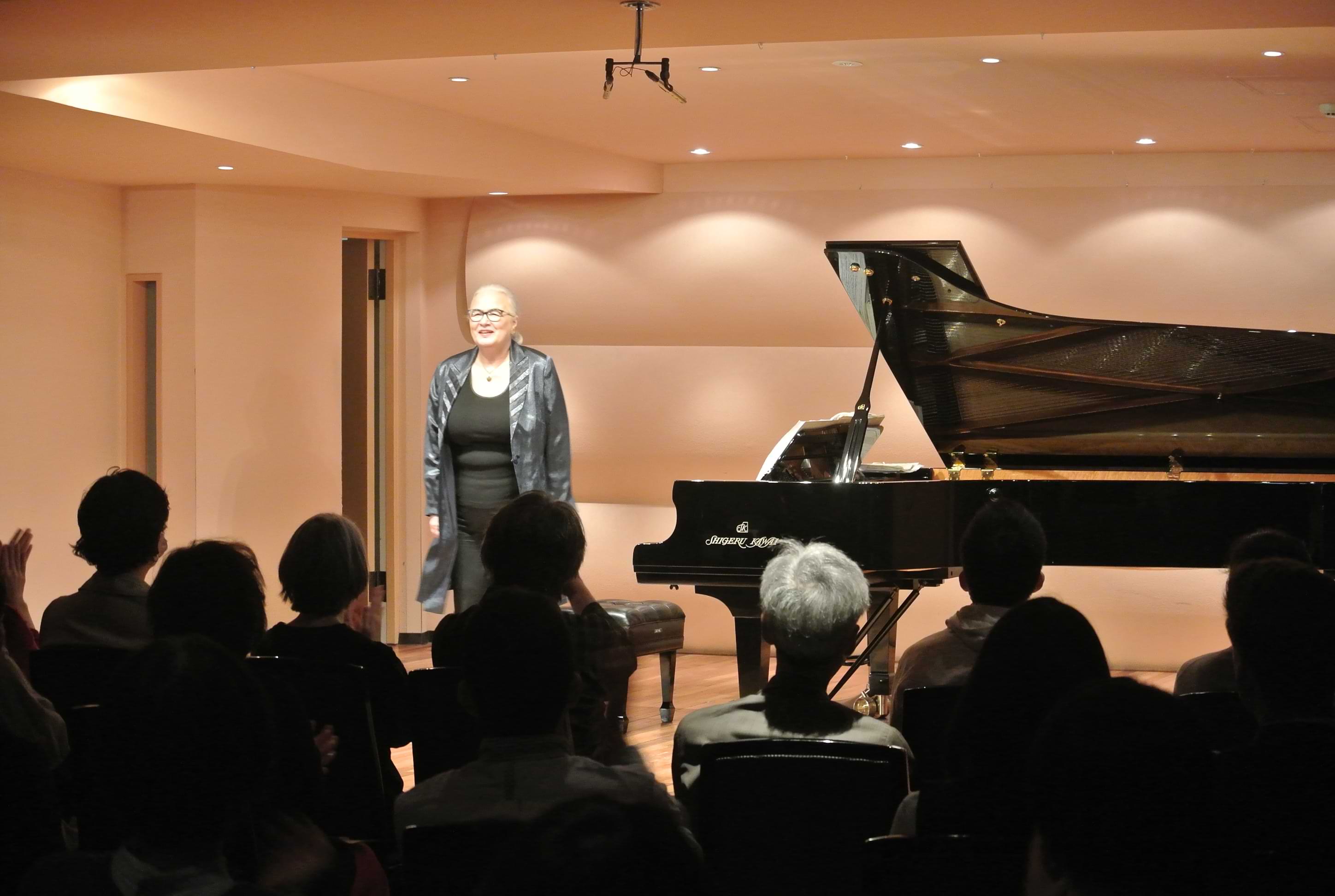
Recital at the Saitama Civic Center Omiya RaiBoC Hall
Encounter with the Works of Bach
Could you tell us about your experiences concerning Bach from your childhood or those that have had a big impact on you?
There was a church I used to go to which was near my house, and that church had an organ which was among the finest in Europe. Organ concerts were held in this church and works by Bach were often played there.
Also, my mother was a singer and she sang a lot of Baroque music, including Bach. Therefore, even as a child, I sang his Cantatas. Bach's music was always very close to me.
Probably the most influential experience I have had concerning Bach, was listening to all of Bach's concertos by Philippe Herreweghe. Herreweghe had a performance group called “Collegium Vocale” which he conducted and I listened to all of Bach's Masses by them as well. Their performances were full of colour and elements of dance, and I learnt a lot about the articulations of Bach and the use of time.
Imagine the conductor rehearsing a Cantata with the orchestra. He has the text of the Cantata in one hand, and explains the meaning of the words to the members of the orchestra. The text helps them to understand what is needed in the performance. I have been performing since I was a child and, as my mother was a singer, I realised that the text plays a great role in a performance. I always feel that words and music are strongly connected.
I have heard that you have studied with Ms. Tatiana Nikolaeva too.
Yes, I studied with her and I also have taken masterclasses with other pianists too. I already had my strong views regarding how to perform Bach, but Prof. Nikolaeva was so marvellous and the beauty of her “Goldberg Variations” is to me unrivalled.
I used to have intense discussions with Prof. Nikolaeva, as she had her own opinions of how to interpret Bach while I also had mine.
The allure of Bach' music
What is the appeal of Bach’s compositions?
Everything. The clarity and lucidity of the forms and styles... the beautiful harmonies, polyphonic melody lines, and the logic behind them. I am also attracted to the mystical elements behind it all.
I remember I was asked the same question by the BBC in London a while ago. At that time, I needed quite a long time to answer those questions, but now, I am quite clear about the beauty of Bach.
In Bach's music, one sees both the elements of him as a human and the elements of him as a composer- Bach was a profound person. His music came from his devotion to his faith being deeply connected to him as a composer and also as a person. His unprecedented skills of composing and deep devotion enabled him to create the mysterious elements unique to Bach.
Some time ago, I went to Switzerland to be on the jury for a competition with Ms. Akiko Ebi. Mr. Arimune Yamamoto (a piano technician of Kawai Europe) was also with us as a member of the group from Kawai. The adjudication was to start at 10 am, so we left Chamonix quite early at about seven o’clock in the morning to go and see the beautiful scenery. Mont Blanc appeared in front of us, and we had coffee in the beautiful sunlight and then made our way back to the competition to adjudicate. On the way back in the car, Mr. Yamamoto played a CD of my “Well-Tempered Clavier Volume 1” by Bach. I wouldn't say it was because of my playing, but Bach's music just penetrated deep into our hearts. Nature ― we felt Bach's encounter with God and that was an amazing experience.
Recent activities
Ms. Poblocka, you recorded Bach's “Well-Tempered Clavier Volume 1” in 2018, followed up by Volume 2.
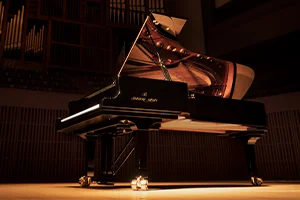
Yes, it was my dream and the people from Kawai made it possible. For any composition, the Shigeru Kawai piano makes it possible to express what I am thinking. These pianos and I fit together well.
By the way, you were an adjudicator at “The 2nd International Chopin Competition on Period Instruments” which was held in October.
Yes, and it was much more interesting than the first one. There were many good instruments and many choices. The contestants seemed to know very well about period instruments and the style of performance of the times that they were used.
When playing Bach's compositions
What is your view on playing Bach on a modern piano?
Well, I have many thoughts on that as I have performed a lot.
For one thing, I don’t think at all of playing in the style of a harpsichord or a fortepiano. I want to bring out the most expression possible on the modern piano which is in front of me. I especially think like this when playing Bach.
It is known that Bach added various ornamentations and spontaneous improvisation when performing.
I also play my own original ornamentations and add my own improvisational expressions where necessary.
If I am correct, Bach did not write down the tempo in the score. What are your thoughts on how to set the tempo?
I study the original score. It is possible to perceive the character of the music from the score and the tonality is clearly written. I often take time where the passage has a big leap in register. Also, I don’t decide on the tempo in advance as it varies according to the space I am performing in. According to various studies on Bach, he seemed to prefer the quicker tempi.
What is your view on pedaling when performing Bach?
I believe in bringing out the best of the piano as an instrument. Some performers value the style of not using the pedal at all. I use the pedal where I think it is needed. For example, for the Prelude of No.1 from Volume 2, I like to play it as if playing on an organ. I cannot play without the pedal if I am to bring out the effect of the organ.
What do you think about Bach's unique polyphony?
It depends on the ability of one’s ear. Piano is an instrument which gives us so much variety depending on articulation, touch and dynamics… especially, the vast choices of articulation make performing on the piano even more appealing.
In the music of Bach, there is a performance trend to be loyal to the performance practice of the past. But I think Bach’s works have great potential for being performed and expressed in a new way.
There is a vast amount of recordings of works by Bach and as I said before, recordings vary - some are without any pedaling and others are quite spontaneous.
Regarding my favorite recordings, one by Edwin Fischer is quite romantic. I was also shocked when I listened to Russian-Jewish Samuil Feinberg. A recent one by Nikolai Demidenko is very emotional. Their performances are completely different from each other and I was deeply moved by each of them. All of these performances are very noble, I think.
I also love Fischer’s Bach.
Back to the topic of the “Well-Tempered Clavier”, how do you feel about the difference between Volume 1 and 2, regarding writing styles and the expressions?
There was some time between Volume 1 and Volume 2 were written.
It is said that Volume 1 was written for his children and pupils, and that Volume 2 was written for himself. Therefore, I feel the philosophical elements in the works of Volume 2 which provokes one's imagination and the possibilities in one's performance. I have been playing Volume 1 since I was a student, so there are marks written by my teacher as a guide. In Volume 2, there were some works that were new to me, so I came to find the expressions on my own. Also, it was Prof. Jerzy Sulikowski who opened my eyes to the appeal of Bach.
Personally, I like No.14 from Volume 2 very much.
Yes, I also enjoy this piece. By the way, the performance of Feinberg's No.14 from Volume 1 is really wonderful, and it starts with “forte”. No other pianist plays like that. I play like other pianists do. Because I know how Feinberg plays, I thought I would like to play like him. So, I practiced and recorded No.14 in various ways. But the next day, I played my original version again and I came to the conclusion that I couldn’t play like somebody else.
I often tell my pupils, even if one tries to pick up various ideas from other pianists, it will never feel right.
One more thing! I give a name or a theme to every one of the Preludes - names which have nothing to do with music.
What kinds of names?
The Prelude in B major is “The Bridge to the Sky” as the music gradually gets brighter.
And by the way, Prelude No.1 is not “Ave Maria” to me…
About the Fugue in C# minor. I recorded 3 different versions, but the recording engineer said “It's not right”. He asked, "Could you play the first note of the piece in C# minor?". Usually, I feel the key in chords, but he wanted the single C# note to suggest the color of the minor key. One can express such a thing by different ways of using time, the touch and the use of breath.
Comments on the Shigeru Kawai piano
It's an instrument which enables things that are necessary to create my own music.
Also, it is an instrument which realizes the imagination. That is quite miraculous. I feel great joy as a pianist that I can work with such an instrument which makes things possible. When I play piano concertos, I often have the urge to do things differently when circumstances change. And the minute I think of it, the Shigeru Kawai piano responds immediately. Of course, the piano tuner plays a big role, and their musical sense seems to be compatible with mine. They are quick to pick up on what I want to do.
About Ewa Pobłocka
Ewa Pobłocka achieved 5th place in the 10th Chopin International Piano Competition, simultaneously winning the Mazurka Award. She emerged victorious at the 1977 International Viotti Music Competition and the 1979 International Festival of Young Laureates in Bordeaux. In 1981, she graduated at the top of her class from the current Academy of Music in Gdańsk. After studying with Conrad Hansen at a university in Hamburg, she continued her musical education under Rudolf Kehrer, Tatiana Nikolaeva, Marta Argerich, and others.
Pobłocka has graced major concert halls worldwide, collaborating with orchestras and conductors such as the London Symphony Orchestra and the Bavarian Radio Symphony Orchestra. Proficient in chamber music, her repertoire spans from Baroque to contemporary music. With over 50 released CDs on labels like Deutsche Grammophon, Polski Nagrania, CD Accord, and Bearton, she has garnered awards and high praise from critics. Notably, her recording of "The Well-Tempered Clavier, Book I" on the NIFC label with a Shigeru Kawai SK-EX piano received acclaim, selected as an outstanding album by Gramophone Magazine and Record Geijutsu.
Known as an outstanding educator, Pobłocka currently teaches at the Feliks Nowowiejski Academy of Music in Bydgoszcz, Poland. She has previously served as a visiting professor at Tokyo University of the Arts and Nagoya University of the Arts in Japan. Conducting masterclasses worldwide, she has also served as a jury member for prestigious international piano competitions such as the Chopin International Piano Competition (2005, 2015, 2021), the Arthur Rubinstein International Piano Master Competition (2021), and the Hamamatsu International Piano Competition (2012).
Ewa Pobłocka has been actively involved in writing, publishing the book "Forte-piano" in 2021. Since around 2018, she has focused extensively on the music of J.S. Bach, hosting radio programs in Poland titled "Start with Bach" and "Bach’s Cases." Her Bach-focused activities include completing the recording of The Well-Tempered Clavier, a Bach recital series scheduled at London's Wigmore Hall in 2021-22, showcasing her dedication to the timeless works of the great composer.